Weather forecasting and early warning systems, flood forecasting agricultural drought monitoring and forecasting
Weather forecasting is
the application of science and technology to predict the conditions of
the atmosphere for a given location and time. People have attempted
to predict the weather informally for millennia and formally
since the 19th century. Weather forecasts are made by collecting
quantitative data about the current state of the atmosphere at a
given place and using meteorology to project how the atmosphere will
change.
Once calculated by hand based mainly upon changes
in barometric pressure, current weather conditions, and sky condition
or cloud cover, weather forecasting now relies on computer-based
models that take many atmospheric factors into account. Human input
is still required to pick the best possible forecast model to base the forecast
upon, which involves pattern recognition skills, teleconnections,
knowledge of model performance, and knowledge of model biases. The inaccuracy
of forecasting is due to the chaotic nature of the atmosphere, the
massive computational power required to solve the equations that describe the
atmosphere, the error involved in measuring the initial conditions, and an
incomplete understanding of atmospheric processes. Hence, forecasts become less
accurate as the difference between current time and the time for which the
forecast is being made (the range of the forecast) increases. The
use of ensembles and model consensus help narrow the error and pick the most
likely outcome.
There are a variety of end uses to weather
forecasts. Weather warnings are important forecasts because they are used to
protect life and property. Forecasts based
on temperature and precipitation are important
to agriculture, and therefore to traders within commodity markets.
Temperature forecasts are used by utility companies to estimate demand over
coming days. On an everyday basis, people use weather forecasts to determine
what to wear on a given day. Since outdoor activities are severely curtailed by
heavy rain, snow and wind chill, forecasts can be used to plan activities
around these events, and to plan ahead and survive them.
Modern methods
It was not until the invention of the electric
telegraph in 1835 that the modern age of weather forecasting
began. Before that, the fastest that distant weather reports could travel
was around 100 miles per day (160 km/d), but was more typically 40–75
miles per day (60–120 km/day) (whether by land or by sea). By the late
1840s, the telegraph allowed reports of weather conditions from a wide area to
be received almost instantaneously, allowing forecasts to be made from
knowledge of weather conditions further upwind.
The two men credited with the birth of forecasting
as a science were an officer of the Royal NavyFrancis Beaufort and
his protégéRobert FitzRoy. Both were influential men
in British naval and governmental circles, and though ridiculed in
the press at the time, their work gained scientific credence, was accepted by
the Royal Navy, and formed the basis for all of today's weather
forecasting knowledge.
Beaufort developed the Wind Force
Scale and Weather Notation coding, which he was to use in his journals for
the remainder of his life. He also promoted the development of reliable tide
tables around British shores, and with his friend William Whewell,
expanded weather record-keeping at 200 British Coast guard stations.
Robert FitzRoy was appointed in 1854 as chief of a
new department within the Board of Trade to deal with the collection
of weather data at sea as a service to mariners. This was the forerunner
of the modern Meteorological Office. All ship captains were tasked
with collating data on the weather and computing it, with the use of tested
instruments that were loaned for this purpose.
A storm in 1859 that caused the loss of the Royal
Charter inspired FitzRoy to develop charts to allow predictions to be
made, which he called "forecasting the weather", thus
coining the term "weather forecast". Fifteen land stations were
established to use the telegraph to transmit to him daily reports of
weather at set times leading to the first gale warning service. His warning
service for shipping was initiated in February 1861, with the use
of telegraph communications. The first daily weather forecasts were
published in The Times in 1861. In the following year a
system was introduced of hoisting storm warning cones at the principal ports
when a gale was expected. The "Weather Book"which
FitzRoy published in 1863 was far in advance of the scientific opinion of the
time.
As the electric telegraph network expanded,
allowing for the more rapid dissemination of warnings, a national observational
network was developed, which could then be used to provide synoptic analyses.
Instruments to continuously record variations in meteorological parameters
using photography were supplied to the observing stations
from Kew Observatory – these cameras had been invented
by Francis Ronaldsin 1845 and his barograph had earlier been used
by FitzRoy.
To convey accurate information, it soon became
necessary to have a standard vocabulary describing clouds; this was achieved by
means of a series of classifications first achieved by Luke Howard in
1802, and standardized in the International Cloud Atlas of
1896.
Numerical prediction
It was not until the 20th century that advances in
the understanding of atmospheric physics led to the foundation of
modern numerical weather prediction. In 1922, English scientist Lewis
Fry Richardsonpublished "Weather Prediction By Numerical Process", after
finding notes and derivations he worked on as an ambulance driver in World War
I. He described therein how small terms in the prognostic fluid dynamics
equations governing atmospheric flow could be neglected, and a finite
differencing scheme in time and space could be devised, to allow numerical
prediction solutions to be found.
Richardson envisioned a large auditorium of
thousands of people performing the calculations and passing them to others.
However, the sheer number of calculations required was too large to be
completed without the use of computers, and the size of the grid and time steps
led to unrealistic results in deepening systems. It was later found, through
numerical analysis, that this was due to numerical instability. The
first computerised weather forecast was performed by a team composed of
American meteorologists Jule Charney, Philip Thompson, Larry Gates, and
Norwegian meteorologist Ragnar Fjørtoft, applied mathematician John
von Neumann, and ENIACprogrammer Klara Dan von Neumann. Practical
use of numerical weather prediction began in 1955, spurred by the
development of programmable electronic computers.
Broadcasts
The first ever daily weather forecasts were
published in The Times on August 1, 1861, and the
first weather maps were produced later in the same year. In
1911, the Met Office began issuing the first marine weather forecasts
via radio transmission. These included gale and storm warnings for areas around
Great Britain. In the United States, the first public radio forecasts were made
in 1925 by Edward B. "E.B." Rideout, on WEEI, the Edison
Electric Illuminating station in Boston. Rideout came from the U.S.
Weather Bureau, as did WBZweather forecaster G. Harold Noyes in 1931.
The world's first televised weather
forecasts, including the use of weather maps, were experimentally broadcast by
the BBC in 1936. This was brought into practice in 1949
after World War II. George Cowling gave the first weather
forecast while being televised in front of the map in 1954. In America, experimental
television forecasts were made by James C Fidler in Cincinnati in either 1940
or 1947 on the DuMont Television Network. In the late 1970s and early
80s, John Coleman, the first weatherman on ABC-TV's Good Morning America,
pioneered the use of on-screen weather satellite information
and computer graphics for television forecasts. Coleman was a
co-founder of The Weather Channel(TWC) in 1982. TWC is now a 24-hour cable
network. Some weather channels have started broadcasting on live
broadcasting programs such as YouTube and Periscope to reach
more viewers.
How models create forecasts
An
example of 500 mbar geopotential height and absolute vorticity prediction
from a numerical weather prediction model
The basic idea of numerical weather prediction is
to sample the state of the fluid at a given time and use the equations
of fluid dynamics and thermodynamics to estimate the state
of the fluid at some time in the future. The main inputs from country-based
weather services are surface observations from automated weather
stations at ground level over land and from weather buoys at sea.
The World Meteorological Organization acts to standardize the
instrumentation, observing practices and timing of these observations
worldwide. Stations either report hourly in METAR reports, or every
six hours in SYNOP reports. Sites launch radiosondes, which
rise through the depth of the troposphere and well into
the stratosphere. Data from weather satellites are used in
areas where traditional data sources are not available. Compared with
similar data from radiosondes, the satellite data has the advantage of global
coverage, however at a lower accuracy and resolution. Meteorological
radar provide information on precipitation location and intensity, which
can be used to estimate precipitation accumulations over time. Additionally, if
a pulse Doppler weather radar is used then wind speed and direction
can be determined.
Commerce provides pilot reports along aircraft
routes, and ship reports along shipping routes. Research flights
using reconnaissance aircraft fly in and around weather systems of
interest such as tropical cyclones. Reconnaissance aircraft are also flown
over the open oceans during the cold season into systems that cause significant
uncertainty in forecast guidance, or are expected to be of high impact 3–7 days
into the future over the downstream continent.
Models are initialized using this
observed data. The irregularly spaced observations are processed by data
assimilationand objective analysis methods, which perform quality control and
obtain values at locations usable by the model's mathematical algorithms
(usually an evenly spaced grid). The data are then used in the model as the
starting point for a forecast. Commonly, the set of equations used to predict
the known as the physics and dynamics of the atmosphere are
called primitive equations. These equations are initialized from the
analysis data and rates of change are determined. The rates of change predict
the state of the atmosphere a short time into the future. The equations are
then applied to this new atmospheric state to find new rates of change, and
these new rates of change predict the atmosphere at a yet further time into the
future. This time stepping procedure is continually repeated
until the solution reaches the desired forecast time.
The length of the time step chosen within the model
is related to the distance between the points on the computational grid, and is
chosen to maintain numerical stability. Time steps for global models
are on the order of tens of minutes, while time steps for regional models
are between one and four minutes. The global models are run at varying
times into the future. The Met Office's Unified Model is run six
days into the future, the European Centre for Medium-Range Weather
Forecasts model is run out to 10 days into the future, while
the Global Forecast System model run by the Environmental Modeling
Center is run 16 days into the future. The visual output
produced by a model solution is known as a prognostic chart, or prog. The
raw output is often modified before being presented as the forecast. This can
be in the form of statistical techniques to remove known biases in
the model, or of adjustment to take into account consensus among other
numerical weather forecasts. MOS or model output statistics is a technique
used to interpret numerical model output and produce site-specific guidance.
This guidance is presented in coded numerical form, and can be obtained for
nearly all National Weather Service reporting stations in the United States. As
proposed by Edward Lorenz in 1963, long range forecasts, those made
at a range of two weeks or more, are impossible to definitively predict the
state of the atmosphere, owing to the chaotic nature of the fluid
dynamics equations involved. In numerical models, extremely small errors
in initial values double roughly every five days for variables such as
temperature and wind velocity.
Essentially, a model is a computer program that
produces meteorological information for future times at given
locations and altitudes. Within any modern model is a set of equations, known
as the primitive equations, used to predict the future state of the
atmosphere. These equations—along with the ideal gas law—are used to
evolve the density, pressure, and potential
temperature scalar fields and the velocity vector
field of the atmosphere through time. Additional transport equations for
pollutants and other aerosols are included in some primitive-equation
mesoscale models as well. The equations used are nonlinear partial
differential equations, which are impossible to solve exactly through
analytical methods, with the exception of a few idealized cases. Therefore,
numerical methods obtain approximate solutions. Different models use different
solution methods: some global models use spectral methods for the
horizontal dimensions and finite difference methods for the vertical
dimension, while regional models and other global models usually use
finite-difference methods in all three dimensions.
Techniques
Persistence
The simplest method of forecasting the weather,
persistence, relies upon today's conditions to forecast the conditions
tomorrow. This can be a valid way of forecasting the weather when it is in a
steady state, such as during the summer season in the tropics. This method of
forecasting strongly depends upon the presence of a stagnant weather pattern.
Therefore, when in a fluctuating weather pattern, this method of forecasting
becomes inaccurate. It can be useful in both short range forecasts and long
range forecasts.
Use of a barometer
Measurements of barometric pressure and the
pressure tendency (the change of pressure over time) have been used in
forecasting since the late 19th century. The larger the change in
pressure, especially if more than 3.5 hPa (2.6 mmHg), the larger
the change in weather can be expected. If the pressure drop is rapid,
a low pressure system is approaching, and there is a greater chance
of rain. Rapid pressure rises are associated with improving weather conditions,
such as clearing skies.
Looking at the sky
Marestail
shows moisture at high altitude, signalling the later arrival of wet weather.
Along with pressure tendency, the condition of the
sky is one of the more important parameters used to forecast weather in
mountainous areas. Thickening of cloud cover or the invasion of a
higher cloud deck is indicative of rain in the near future. High
thin cirrostratus clouds can create halos around
the sun or moon, which indicates an approach of a warm
front and its associated rain. Morning fog portends
fair conditions, as rainy conditions are preceded by wind or clouds that
prevent fog formation. The approach of a line of thunderstorms could
indicate the approach of a cold front. Cloud-free skies are indicative of
fair weather for the near future. A bar can indicate a coming
tropical cyclone. The use of sky cover in weather prediction has led to
various weather lore over the centuries.
Nowcasting
The forecasting of the weather within the next six
hours is often referred to as nowcasting. In this time range
it is possible to forecast smaller features such as individual showers and
thunderstorms with reasonable accuracy, as well as other features too small to
be resolved by a computer model. A human given the latest radar, satellite and
observational data will be able to make a better analysis of the small scale
features present and so will be able to make a more accurate forecast for the
following few hours. However, there are now expert systems using
those data and mesoscale numerical model to make better extrapolation,
including evolution of those features in time.
Use of forecast models
In the past, the human forecaster was responsible
for generating the entire weather forecast based upon available observations. Today,
human input is generally confined to choosing a model based on various
parameters, such as model biases and performance. Using a consensus of
forecast models, as well as ensemble members of the various models, can help
reduce forecast error. However, regardless how small the average error
becomes with any individual system, large errors within any particular piece of
guidance are still possible on any given model run. Humans are required to
interpret the model data into weather forecasts that are understandable to the
end user. Humans can use knowledge of local effects that may be too small in
size to be resolved by the model to add information to the forecast. While
increasing accuracy of forecast models implies that humans may no longer be
needed in the forecast process at some point in the future, there is currently
still a need for human intervention.
Analog technique
The analog technique is a complex way of making a
forecast, requiring the forecaster to remember a previous weather event that is
expected to be mimicked by an upcoming event. What makes it a difficult
technique to use is that there is rarely a perfect analog for an event in the
future. Some call this type of forecasting pattern recognition. It remains
a useful method of observing rainfall over data voids such as oceans, as
well as the forecasting of precipitation amounts and distribution in the
future. A similar technique is used in medium range forecasting, which is known
as teleconnections, when systems in other locations are used to help pin down
the location of another system within the surrounding regime. An example
of teleconnections are by using El Niño-Southern Oscillation (ENSO)
related phenomena.
Communicating forecasts to the public
Most end users of forecasts are members of the
general public. Thunderstorms can create strong winds and
dangerous lightningstrikes that can lead to deaths, power outages, and
widespread hail damage. Heavy snow or rain can bring transportation and
commerce to a stand-still, as well as cause flooding in low-lying areas. Excessive heat or cold
waves can sicken or kill those with inadequate utilities, and drought
scan impact water usage and destroy vegetation.
Several countries employ government agencies to
provide forecasts and watches/warnings/advisories to the public in order to
protect life and property and maintain commercial interests. Knowledge of what
the end user needs from a weather forecast must be taken into account to
present the information in a useful and understandable way. Examples include
the National Oceanic and Atmospheric Administration's National
Weather Service(NWS) and Environment Canada's Meteorological Service(MSC).
Traditionally, newspaper, television, and radio have been the primary outlets
for presenting weather forecast information to the public. In addition, some
cities had weather beacons. Increasingly, the internet is being used due
to the vast amount of specific information that can be found. In all
cases, these outlets update their forecasts on a regular basis.
Severe weather alerts and advisories
A major part of modern weather forecasting is the
severe weather alerts and advisories that the national weather services issue
in the case that severe or hazardous weather is expected. This is done to
protect life and property. Some of the most commonly known of severe
weather advisories are the severe thunderstorm and tornado
warning, as well as the severe thunderstorm and tornado watch.
Other forms of these advisories include winter weather, high
wind, flood, tropical cyclone, and fog. Severe weather advisories and
alerts are broadcast through the media, including radio, using emergency
systems as the Emergency Alert System, which break into regular
programming.
Low temperature forecast
The low temperature forecast for the current day is
calculated using the lowest temperature found between 7 pm
that evening through 7 am the following
morning. So, in short, today's forecasted low is most likely tomorrow's
low temperature.
Specialist forecasting
There
are a number of sectors with their own specific needs for weather forecasts and
specialist services are provided to these users.
Air traffic
Because the aviation industry is especially
sensitive to the weather, accurate weather forecasting is essential. Fog or
exceptionally low ceilings can prevent many aircraft from landing and
taking off. Turbulence and icing are also significant
in-flight hazards. Thunderstorms are a problem for all aircraft because of
severe turbulence due to their updrafts and outflow
boundaries, icing due to the heavy precipitation, as well as
large hail, strong winds, and lightning, all of which can cause severe
damage to an aircraft in flight. Volcanic ash is also a significant
problem for aviation, as aircraft can lose engine power within ash
clouds. On a day-to-day basis airliners are routed to take advantage of
the jet streamtail wind to improve fuel efficiency. Aircrews are briefed
prior to takeoff on the conditions to expect en route and at their
destination. Additionally, airports often change which runway is
being used to take advantage of a headwind. This reduces the distance
required for takeoff, and eliminates potential crosswinds.
Marine
Commercial and recreational use of waterways can be
limited significantly by wind direction and speed, wave periodicity
and heights, tides, and precipitation. These factors can each influence the
safety of marine transit. Consequently, a variety of codes have been
established to efficiently transmit detailed marine weather forecasts to vessel
pilots via radio, for example the MAFOR(marine forecast). Typical
weather forecasts can be received at sea through the use of RTTY, Navtex and Radiofax.
Agriculture
Farmers rely on weather forecasts to decide
what work to do on any particular day. For example, drying hay is
only feasible in dry weather. Prolonged periods of dryness can
ruin cotton, wheat, and corncrops. While corn crops can be
ruined by drought, their dried remains can be used as a cattle feed substitute
in the form of silage. Frosts and freezes play havoc with crops
both during the spring and fall. For example, peach trees in full
bloom can have their potential peach crop decimated by a spring freeze. Orange groves
can suffer significant damage during frosts and freezes, regardless of their
timing.
Forestry
Weather forecasting of wind, precipitations and
humidity is essential for preventing and controlling wildfires. Different
indices, like the Forest fire weather index and the Haines
Index, have been developed to predict the areas more at risk to experience
fire from natural or human causes. Conditions for the development of harmful
insects can be predicted by forecasting the evolution of weather, too.
Utility companies
Electricity and gas companies rely on weather
forecasts to anticipate demand, which can be strongly affected by the weather.
They use the quantity termed the degree day to determine how strong of a use
there will be for heating (heating degree day) or cooling (cooling degree day).
These quantities are based on a daily average temperature of 65 °F
(18 °C). Cooler temperatures force heating degree days (one per degree
Fahrenheit), while warmer temperatures force cooling degree days. In
winter, severe cold weather can cause a surge in demand as people turn up their
heating. Similarly, in summer a surge in demand can be linked with the
increased use of air conditioning systems in hot weather. By
anticipating a surge in demand, utility companies can purchase additional
supplies of power or natural gas before the price increases, or in some
circumstances, supplies are restricted through the use
of brownouts and blackouts.
Other commercial companies
Increasingly, private companies pay for weather
forecasts tailored to their needs so that they can increase their profits or
avoid large losses. For example, supermarket chains may change the stocks
on their shelves in anticipation of different consumer spending habits in
different weather conditions. Weather forecasts can be used to invest in the
commodity market, such as futures in oranges, corn, soybeans, and oil.
Military applications
United Kingdom Armed Forces
Royal
Navy
The UK Royal Navy, working with the
UK Met Office, has its own specialist branch of weather observers and
forecasters, as part of the Hydrographic and Meteorological (HM)
specialisation, who monitor and forecast operational conditions across the
globe, to provide accurate and timely weather and oceanographic information to
submarines, ships and Fleet Air Arm aircraft.
Royal Air Force
A mobile unit in the RAF, working with the
UK Met Office, forecasts the weather for regions in which British, allied
servicemen and women are deployed. A group based at Camp Bastion provides
forecasts for the British armed forces in Afghanistan.
United States Armed Forces
US Navy
Similar to the private sector, military weather
forecasters present weather conditions to the war fighter community. Military
weather forecasters provide pre-flight and in-flight weather briefs to pilots
and provide real time resource protection services for military installations.
Naval forecasters cover the waters and ship weather forecasts. The United
States Navy provides a special service to both themselves and the rest of the
federal government by issuing forecasts for tropical cyclones across the
Pacific and Indian Oceans through their Joint Typhoon Warning Center.
US Air Force
Within the United States, Air Force Weather
provides weather forecasting for the Air Force and the Army. Air
Force forecasters cover air operations in both wartime and peacetime
operations and provide Army support; United States Coast
Guard marine science technicians provide ship forecasts for ice breakers
and other various operations within their realm; and Marine forecasters
provide support for ground- and air-based United States Marine
Corpsoperations. All four military branches take their initial enlisted
meteorology technical training at Keesler Air Force Base. Military
and civilian forecasters actively cooperate in analyzing, creating and
critiquing weather forecast products.
In 1864, two severe cyclonic storms in quick
succession hit the east coast of India, causing enormous loss of human lives
and property the first one struck Kolkata in October and the second one struck
Machilipatnam in November. Concerned with these disasters, the Government
appointed a committee in 1865 to formulate a scheme to develop a system of
cyclone warnings. On the recommendations of the committee, Kolkata became the
first port where a storm warning system was organised in 1865. Thus the issue
of storm warning messages started even before the establishment of the Department
in 1875. The storm warning scheme for west coast ports (Mumbai, Karachi,
Ratnagiri, Vengurla, Karwar and Kumta) came into force in 1880.
In 1882,
besides Kolkata, the ports at Sagar Islands, Mud Port and Diamond Harbour were
also included in the list of ports getting storm warning messages. By 1886, the
system of early warnings against cyclones was extended to cover all Indian
ports. Upto 1898, two different systems
of storm warning signals (one for the east coast ports and another for west
coast ports) were in use. As this was leading to some confusion, a uniform
system of storm warning signals was introduced at all the Indian ports from
1898. Kolkata office was responsible for issuing storm warning to all the ports
(including those of Burma) around the Bay of Bengal, while the west coast ports
were served by the Bombay Meteorological Reporter initially and later from
Shimla which was then the headquarters of the Department. After the shift of
the HQ of the Department from Shimla to Pune in 1928, the storm warning work
for west coast was done from Pune. From 1928 till 1945, the storm warning work
was managed between the Kolkata and Pune offices for Bay of Bengal and Arabian
Sea respectively.
Cyclone warning is one of the most important
functions of the India Meteorological Department and it was the first service
undertaken by the Department as early as in 1865 and thus the service started
before the establishment of the department in 1875.
Organisational
Structure
In 1969, the Government of India appointed a
committee called the Cyclone Distress Mitigation committee (CDMC) for Andhra
Pradesh to examine various measures to mitigate human suffering and reduce loss
of life and property due to cyclonic storms. Subsequently similar committees
were set up for Orissa and West Bengal. The Cyclone Distress Mitigation
committees for Andhra Pradesh and Orissa recommended in 1971-72 that the India
Meteorological Department should establish storm warning centres at
Visakhapatnam and Bhubaneshwar for issuing cyclone warnings to coastal Andhra
Pradesh and coastal Orissa respectively. Consequently, a storm warning centre
was set up at Visakhapatnam in 1974, and at Bhubaneshwar in 1973 for catering
to the needs of Andhra Pradesh and Orissa respectively.
In pursuance of the recommendation of Cyclone
Review Committee, another Storm Warning Centre was established at Ahmedabad in
1988 for catering the needs of Gujarat, union territory of Diu, Daman, Dadra
and Nagar Haveli. With effect from 1st
July 1988 Regional Specialized Meteorological Centre (RSMC) Tropical Cyclones
New Delhi has been assigned the responsibility of issuing Tropical Weather
Outlooks and Tropical Cyclone Advisories for the benefit of the countries in
the WMO/ESCAP Panel region bordering the Bay of Bengal and the Arabian Sea,
namely, Bangladesh, Maldives, Myanmar, Oman, Pakistan, Sri Lanka and Thailand.
As per one of the recommendations of the Cyclone Review Committee (CRC), a
Cyclone Warning Directorate co-located with RSMC Tropical Cyclones New Delhi was
established in 1990 in the Office of the Director General of Meteorology, New
Delhi to co-ordinate the cyclone warning work in the country in totality.
ACWCs / CWCs
With the establishment of the additional Centres at Bhubaneshwar and
Visakhapatnam, the Storm Warning Centres at Kolkata, Chennai and Mumbai were
named as Area Cyclone Warning Centres (ACWC) and the Storm Warning Centres at
Visakhapatnam, Bhubaneshwar and Ahmedabad as Cyclone Warning Centres (CWC).
CWCs Visakhapatnam, Bhubaneshwar and Ahmedabad function under the control of
the ACWCs-Chennai, Kolkata and Mumbai respectively. M. C. Hyderabad liaises
between CWC Visakhapatnam and Andhra Pradesh Government officials; warnings
issued by CWC Visakhapatnam are sent to M. C. Hyderabad also for briefing the
Andhra Pradesh Government officials at the State Capital.
The present organisational structure for cyclone
warnings is a three-tier one, with the ACWCs/CWCs actually performing the
operational work of issuing the bulletins and warnings to the various user
interests, while the cyclone warnings (Directorate) New Delhi and the Deputy
Director General of Meteorology (Weather Forecasting), through Weather Central,
Pune coordinates and guides the work of the ACWCs/CWCs, exercises supervision
over their work and takes necessary measures for continued improvement and
efficiency of the storm warnings system of the country as a whole. The ultimate
responsibility for operational storm warning work for the respective areas
however, rests with the ACWCs and CWCs.
Early flood
warning system to be tested this monsoon in Chennai
A comprehensive decision-support system, aimed
at mitigating rain-related suffering of Chennai residents, will be put to test
during the upcoming monsoon season in the city. The Chennai Flood Early Warning
System (CFLOWS), predicting flood inundation scenarios for Chennai, based on a
hydrodynamic model with help of forecast and observed rainfall, reservoir and
river levels and other parameters from various agencies, has been developed by
National Centre for Coastal Research (NCCR), IIT-Mumbai, IIT-Madras and
Institute of Remote Sensing-Anna University.
CFLOWS would be able to predict
locations at risk of flooding and depth of flooding based on the best forecast
products of India Meteorological Department and National Centre for Medium
Range Weather Forecasting.
It will disseminate alerts five
days in advance. It will be integrated with TNSMART, an application for flood
mitigation measures yet to be launched, before being tested this monsoon. “The
early warning information generated via CFLOWS will be communicated to revenue
officials through TNSMART. Feedback will be received to evaluate alerts through
same channel
Community-Based
Flood Early-Warning System | India
To enhance the resilience of 45 vulnerable communities in the
Indian Himalayan region to flood hazards, a collaboration encompassing ICIMOD,
Aranyak and SEE created the Community-Based Flood
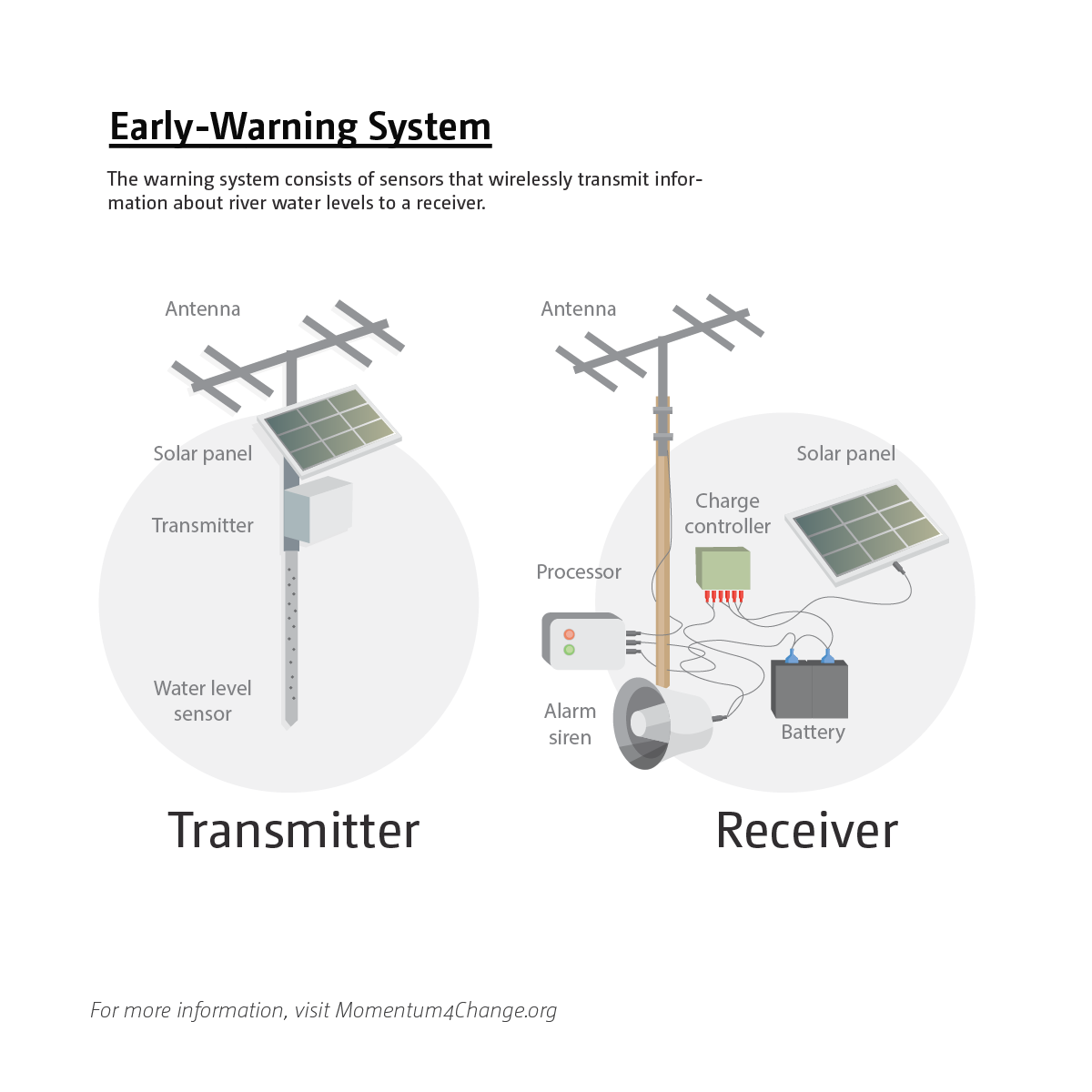
Early-Warning System. The information and communications technology
(ICT) enabled system uses a flood sensor attached to the transmitter to detect
rising water levels. When the water reaches a critical level, a signal is
wirelessly transmitted to the receiver. The flood warning is then disseminated
via mobile phones to appropriate agencies and vulnerable communities
downstream. Critical flood levels are set with the help of local communities.
Fast
facts:
·
In
2013, five community-based flood early warning systems were installed in the
Singora and Jiadhal rivers.
·
The
system installed in the Singora River sends flood warning signals to 20
flood-vulnerable communities downstream; 25 flood-vulnerable communities
receive warnings from the system installed in the Jiadhal River.
·
During
the flood season of 2013, the flood early-warning system installed in the
Jiadhal River successfully informed community members of pending floods,
helping them save assets and lives.
The
problem
The Hindu Kush
Himalayan region is one of the most dynamic and complex mountain systems in the
world. It is also extremely fragile and sensitive to the effects of climate
change. Climate change is gradually increasing the frequency and magnitude of
extreme weather events and natural hazards in the region, which has led to
higher levels of risk and uncertainty.
One of the effects of
climate change is the formation of meltwater lakes on the lower sections of
glaciers in the Himalaya region. Because such lakes are inherently unstable and
subject to catastrophic flood surges they are potential sources of danger to
people and property in the valleys below them.
The
solution
The Community-based
Flood Early-warning System is an ICT-enabled system to detect and respond to
flood emergencies that are prepared and managed by the communities. The
wireless system manages flood or flash flood risk by providing early warnings
to downstream communities and enhances cooperation between upstream and
downstream communities in the sharing of flood information.
This ICT solution
consists of two units – a transmitter and a receiver. The transmitter is
installed along the riverbank, and the receiver is installed at a house near
the river. A flood sensor attached to the transmitter detects rising water
levels. When the water reaches a critical level, a signal is wirelessly
transmitted to the receiver. The flood warning is then disseminated via mobile
phone to concerned agencies and vulnerable communities downstream. Critical
flood levels are set with the help of the local community.

Helping
people
The system saves
lives and property by providing lead time for downstream communities to prepare
and respond to the threat of flash floods. It also enhances cooperation between
upstream and downstream communities in sharing flood information.
During the 2013 flood
season, the Community-based Flood Early-warning System installed in the Jiadhal
River successfully informed community members in Dihiri of pending floods,
helping them save assets, including cattle and pigs, worth approximately USD
3,300.

Spillover
effect
The
Community-based Flood Early-warning System project representatives are working
with the local government authority to scale up the initiative. This
collaboration involves creating district flood management plans and building
the capacity of communities to control the system’s equipment. Once the
initiative is replicated in other flood-prone areas in the district, the
communities can take ownership of the system to sustain it for the long term.
Project
representatives have been approached institutions in other countries to help
replicate the system in flood-vulnerable areas. In Afghanistan, initial
discussions have been held and a partner has been to initiate the process. In
Nepal, ICIMOD's initiative on Koshi River Basin Management has included the
Community-based Flood Early-warning System methodology in its planning and
initial discussions are continuing.

Weather Forecast System
India Meteorological
Department (IMD) operates a dedicated weather and climate monitoring, detection
and warning services useful for various sectors of economy. Monsoon prediction
and the weather forecasting systems in the country are comparable to the best
in the world. However, efforts are continuously being made to further enhance
the level of efficiency of the forecasting systems
Improvement of
weather forecasting services is a continuous process. Government has initiated
a comprehensive modernization programme for IMD covering (i) up-gradation of
observation systems (ii) advanced data assimilation tools (iii) advanced
communication and IT infrastructure (iv) high performance computing systems and
(v) intensive/sophisticated training of IMD personnel. Forecasts, early warning
of severe weather events and advisories are issued by IMD at national, state
and district levels. In order to provide early warning of severe weather
events, IMD has setup a network of State Meteorological Centres to have better
coordination with the state and district level agencies.
To improve the
prediction of Monsoon, National Monsoon Mission was launched in 2012. Under the
National Monsoon Mission initiative, the Indian Institute of Tropical
Meteorology (IITM), Pune, Indian National Centre for Ocean Information Services
(INCOIS), Hyderabad and National Centre for Medium Range Weather Forecasting
(NCMRWF), Noida have embarked upon to build state-of-the-art coupled ocean
atmospheric models for (i) improved prediction of monsoon rainfall on extended
range to seasonal time scale (11 days to one season) and (ii) improved
prediction of temperature, rainfall and extreme weather events on short to
medium range time scale (up to 10 days) so that forecast skill gets
quantitatively improved further for the operational services of IMD.
Through Indo-US
collaboration, a “Monsoon Desk” has been set up for working jointly for
improving seasonal forecast of Indian monsoon rainfall. Through this forum,
Indian and US Scientists are exchanging their ideas and sharing their
expertise. This effort has led to appreciable improvements in the efficiency of
models in making better forecasts.
The monsoon forecast for
the country is prepared by Climate Prediction Unit of Climate Research and
Services Division (CR&S), IMD, Pune. The present long range forecast system
based on the statistical models has shown some useful skill in predicting all
India seasonal rainfall including the deficient monsoon season rainfall during
2015. However, in order to overcome the limitations of the statistical models
used so far, a state of the art dynamical prediction system was implemented by
MoES for generating operational long range monsoon forecasts.
The Gramin Krishi
Mausam Seva (GKMS) of IMD has been successful in providing the crop specific
advisories to the farmers through different print/visual/Radio/ IT based media
including short message service (SMS) and Interactive Voice Response Service
(IVRS) facilitating for appropriate field level actions. Weather forecast based
agro-meteorological advisories are disseminated through Kisan portal launched
by the Ministry of Agriculture and also under public private partner. At
present, the GKMS products are disseminated through SMS and IVRS to about
21million farmers in the country. As per the recent National Council of Applied
Economic Research (NCAER) report, farming community of the country is using the
GKMS service products of India Meteorological Department (IMD) for critical
farm operations Viz. (i) Management of sowing (Delayed onset of rains); (ii)
Changing crop variety (Delay in rainfall); (iii) Spraying Pesticides for
disease control (occurrence of rainfall); (iv) Managing Irrigation (Heavy
rainfall Forecast).
The third party
assessment by the National Council of Applied Economic Research (NCAER) on the
agromet services provided by the ministry concluded that the annual economic
benefit for the farmers cultivating 4 principal crops (Wheat, Rice, Sugarcane
and Cotton) was Rs 42,000 Crore in 2015.
An early warning system can
be implemented as a chain of information communication
systems and comprises sensors, event
detection and decision subsystems. They work together to forecast and
signal disturbances that adversely affect the stability of the physical
world, providing time for the response system to prepare for the adverse event
and to minimize its impact.
To
be effective, early warning systems need to actively involve the communities at
risk, facilitate public education and awareness of risks, effectively
disseminate alerts, and warnings and ensure there is constant state of
preparedness. A complete and effective early warning system supports
four main functions: risk analysis, monitoring and warning; dissemination
and communication; and a response capability.
Application
Risk
analysis involves systematically collecting data and undertaking risk
assessments of predefined hazards and vulnerabilities. Monitoring and warning
involves a study of the factors that indicate a disaster is imminent, as well
as the methods used to detect these factors. Dissemination and communication
concerns communicating the risk information and warnings to reach those in
danger in a way that is clear and understandable. Finally, an adequate response
capability requires the building of national and community response plan,
testing of the plan, and the promotion of readiness to ensure that people know
how to respond to warnings.
An
early warning system is more than a warning system, which is simply a
means by which an alert can be disseminated to the public.
History
Since
the Indian Ocean tsunami of 26 December 2004, there has been a surge
of interest in developing early warning systems. However, early warning
systems can be used to detect a wide range of events, such as vehicular
collisions, missile launches, disease outbreaks, and so forth. See warning
system for a wider list of applications that can be also be supported by
early warning systems.
Early warning systems are means by which people
receive relevant and timely information in a systematic way prior to a disaster
in order to make informed decisions and take action. The word system is used to
refer to the interplay between an array of elements aimed at facilitating
communication and prompt response to protect and aid those in need.
There are four basic elements to an early warning
system where each part must function efficiently for the system to be
successful:
·
Risk knowledge builds the baseline understanding
about risks (hazards and vulnerabilities) and priorities at a given
level.
·
Monitoring is the logical follow-on activity to keep
up-to-date on how those risks and vulnerabilities change through time.
·
Response capability insists on each level being
able to reduce risk once trends are spotted and announced — this may be through
pre-season mitigation activities, evacuation or duck-and-cover reflexes,
depending on the lead-time of a warning.
·
Warning communication packages the monitoring
information into actionable messages understood by those that need, and are
prepared, to hear them.
·
An early warning system (EWS) is technology
and associated policies and procedures designed to predict and mitigate the
harm of natural and human-initiated disasters and other undesirable events.
·
Early warning systems for natural hazards
include those designed for floods, earthquakes, avalanches, tsunamis,
tornadoes, landslides and drought. Other systems exist for a variety of events
including missile launches, road conditions and disease outbreaks.The
United Nations' International Strategy for Disaster Reduction (ISDR)
recommends that early warning systems have the following four components:
·
Risk knowledge: Data should be systematically
collected and analyzed and risk assessments performed.
·
Monitoring and warning service: Systems should be
in place to monitor hazards and provide early warning services.
·
Dissemination and communication: Risk information
and early warning messages must be delivered.
·
Response capability: Systems should be in place to
respond to events.
·
In IT (information technology), early warning
systems are used in a variety of environments. The Healthcare Alert
Network (HAN) messaging system uses a variety of communication tools,
including email, broadcast faxes, television and phone calls, to alert local,
state and federal authorities and the media about urgent health threats and
necessary actions. The SANS Instituterefers to its Internet Storm
Center, which tracks and reports on security threats, as an early warning
system for the Internet. Social media analytics software can provide
an early warning system for negative customer feedback, such as complaints
about products or customer service. Early warning systems for data centers
can be used to detect potentially dangerous conditions in the physical
environment as well as in the hardware and software systems.
·
Flood forecasting is the use of
forecasted precipitation and stream flow data in rainfall-runoff and stream
flow routing models to forecast flow rates and water levels for periods
ranging from a few hours to days ahead, depending on the size of the watershed
or river basin. Flood forecasting can also make use of forecasts of
precipitation in an attempt to extend the lead-time available.
·
Flood forecasting is an important component
of flood warning, where the distinction between the two is that the
outcome of flood forecasting is a set of forecast time-profiles of channel
flows or river levels at various locations, while "flood warning" is
the task of making use of these forecasts to tell decisions on warnings of
floods.
·
Real-time flood forecasting at regional area can be
done within seconds by using the technology of artificial neural
network. Effective real-time flood forecasting models could be useful for
early warning and disaster prevention.
Drought
Early Warning System
A multi-institutional drought early warning
system exists in the country, to monitor the behaviour of the agro-climate
indicators like rainfall, temperature, reservoirs levels and crop conditions,
on a weekly basis from June to September. This early warning system called the
‘Crop Weather Watch Group’, enables the Government to intervene in July- August
itself, instead of waiting for an assessment of the damage at the end of the cropping
season (October- November). The country has a well-established drought response
machinery at the national, state, district and village levels, with
institutional mechanisms, to integrate the participation of political and civil
society organizations.
From an economic perspective, ‘agricultural
drought’ may be viewed as an exogenous, supply-side shock, which is widely
recognised as resulting directly in sharp reductions in agricultural production
and employment apart from other losses associated with declines in rural
income. In addition, meteorological drought, may result in hydrological
conditions that have a direct impact on non-agricultural production, including
hydro-electric power generation and drinking water supply.
Flood
Warning Systems in India:
Flood forecasting and warning systems in
India, consists of structural flood management measures such as embankments and
channels, which aim at minimizing flood damage and also better planning of
rescue/relief operations. Scientific Flood Forecasting in India is with 173
flood forecasting stations in nine major river systems, and 71 river sub-basins
in 15 states. The Central Water Commission (CWC) is in charge of these systems.
For other intra-state rivers, states have to establish such systems, usually
they are not in place.
Each year, CWC issues nearly 6,000 forecasts
during the flood season, usually 12 to 48 hours in advance. For this, CWC has
hydrological data from 700 Gauge and Discharge sites and hydro-meteorological
data over 500 rain gauge stations, through a network of about 550 wireless
stations. IMD provides synoptic weather reports, weather forecast/heavy
rainfall warnings etc., to CWC. Flood forecasting systems have received support
in each Five year Plan, to improve the systems needed, to issue more accurate
and timely warnings.
Cyclone
Warning Systems
The India Meteorological Department (IMD),
follows a four-stage warning system for issuing warnings for tropical cyclones.
A “Pre-cyclone Watch” is issued whenever a depression forms over the Bay of
Bengal or Arabian Sea, followed by a “Cyclone Alert”, issued 2-3 days in
advance of commencement of bad weather along the coast. In the third stage,
Cyclone Warnings are issued 1-2 days in advance, which specify the expected
place and time of landfall of the tropical cyclone. The final stage is known as
“postlandfall Outlook”, which is issued 12 hours in advanced of landfall and
contains location specific forecast of landfall along with other warning
details. The Cyclone Warning Organization in India has a 3-tier system to cater
to the needs of the maritime States.
These
are:
Cyclone Warning Division (CWD) set up at IMD
Head Quarters to co-ordinate and supervise cyclone warning operations in the
country and to advise the Govt. at the apex level;
§ Area Cyclone Warning Centres
(ACWC) at Chennai, Mumbai and Kolkata and Cyclone Warning Centres at
Visakhapatnam, Ahmedabad and Bhubaneswar.
The cyclone warning work is also supervised
and coordinated by the Forecasting Division at Pune.
With new observation systems such as buoys,
Doppler Radars and new generation satellites, these forecasts are likely to
improve further. Five Doppler Weather Radars (DWRs) have started functioning
along the east coast at Visakapattinam, Kolkata, Machilipatnam, Chennai and
Sriharikota.
End-to-End
warning system
A system that generates hazard information,
constitutes one end and the system that delivers user focused information, to
derive a desired response from risk communities, constitutes the other end of
the system. Early warning information, effectively generated, communicated and
applied, should lead to a change in decisions, that generate improved outcomes
in the system of interest. This involves the following elements: the message to
be communicated – weather/flood prediction and interpretation into local
outlooks; the communication of the message – translation, message construction
and dissemination; the receipt of and response to the message; and a feedback
mechanism – examining the various aspects of the system with a view to improve
its performance. Much more effort also needs to be applied to this end of the
implementation chain, and pilot studies are recommended, as an integral part of
policy planning.
There are serious gaps in almost all
phases of an early warning system: poor quality and less dense observation
equipments, outmoded data analysis, poor prediction and risk assessment
practices, non-generation and poor dissemination of user friendly forecast
products, both in their content and frequency, and understandably less or no
participation of communities, in the early warning system. The gaps in
different phases of the early warning system, naturally undermine the
effectiveness of the system.
'India
may face an intense and increased water deficit next year'
Water
deficits will increase and intensify in India in 2019, says the latest edition
of Global Water Monitor & Forecast Watch List (November 2018). It
represents the regions which are likely to encounter significant water
anomalies in the next few months. The results showcase that exceptional water
deficits occur throughout Gujarat in the west and severe to exceptional
deficits from Madhya Pradesh through Karnataka, as well as in Punjab,
Rajasthan, Haryana, and India’s far northeast.
The
report presented by IScience (US based limited liability corporation) states
the findings from the latest Water Security Indicator Model (WSIM) analysis of
global water anomalies using observed temperature and precipitation through
October 2018 and an ensemble of forecasts issued the last week of October 2018.
ISciences Water Security Indicator Model (WSIM) monitors and forecasts water
anomalies on a near global basis. WSIM products include data, visualisations
and reports. WSIM includes algorithms to assess the impacts of water anomalies
on people, agriculture and electricity generation. WSIM has been run
continuously since April 2011 and has been validated against subsequent
monitoring based on observed data.
The
forecast predicts severe to exceptional surplus water for regions including
Jammu and Kashmir, Himachal Pradesh, Uttar Pradesh and Mizoram. Moderate to
severe deficits were forecast for Bihar. From February through April, deficits
in India are expected to moderate overall and some regions in the country’s
eastern third will normalise. However, intense deficits will persist throughout
Gujarat and Madhya Pradesh and along the Tungabhadra River through Karnataka.
The forecast for the final months — May through July (2019) — indicates
primarily moderate deficits in India and pockets throughout the region. Some
surpluses are expected in Jammu and Kashmir, northern Pakistan, along the
Gandaki River in central Nepal, and pockets of Tamil Nadu.
The
12-month forecast through July 2019 indicates exceptional (greater than 40
years) water deficits in Maharashtra, Telangana, Andhra Pradesh,
Karnataka, and Madhya Pradesh.
The
previous year datasets are used to derive model value. The results of previous
model state that three of the five hottest Septembers on record in India have
occurred in the last three years — 2015, 2017, and 2018. Though this September’s
extreme heat was unrelated to El Niño — which usually introduces warm dry
conditions — El Niño is being blamed for low rainfall during the
June-to-September monsoon season. The monsoon rain deficits have caused
drought-like conditions in almost a third of Indian districts, and added stress
for the farmers.
India’s
coffee production is expected to fall to its lowest in five years due to flood
damage to plantations in southern states such as Kerala and Karnataka. India
exports about three quarters of the coffee it produces, and flood damage has
been reported in all key producing areas of the country. The future forecast
will help visualise the impact and intensity at a large scale.
It
also provides highlights of regional water forecasts for the United States,
Canada, Mexico, Central America, South America, Europe, Africa, Middle East,
Central Asia and Russia, Southeast Asia and the Pacific East Asia, Australia
and New Zealand.

No comments:
Post a Comment